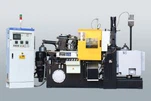
Traditional die casting technology and equipment are quite mature, especially horizontal cold chamber die casting machines and horizontal die casting processes. Their injection and mold clamping devices have extremely strong process adaptability. Therefore, if extrusion casting technology cannot be combined with traditional die casting equipment, its widespread application will be limited. Taking this step, another branch of extrusion casting technology will emerge: extrusion die casting technology. In other words, applying extrusion casting technology to a traditional die casting machine is extrusion die casting technology. Based on the characteristics of the extrusion die casting process itself, and by making corresponding improvements and modifications to a traditional die casting machine, this equipment becomes a completely new extrusion die casting machine.
1. Correct and Comprehensive Understanding of Die Casting Technology and the Functions of Traditional Die Casting Machines
Grasping the principles of extrusion casting technology, simply applying it to a traditional die casting machine is not difficult. The key is to break through traditional concepts. It requires a comprehensive and thorough understanding of the performance of traditional die casting machines, a deep understanding of the traditional die casting process, and the elimination of preconceived notions. In fact, modern traditional die-casting machines are already quite comprehensive in function. They can perform not only ordinary die casting, but also extrusion die casting and core-based extrusion die casting; they can perform various low-pressure casting, differential pressure casting, and gravity casting. With the addition of a vacuum device, they can also perform vacuum suction casting, vacuum die casting, and vacuum extrusion die casting. If we broaden our thinking further and combine it with semi-solid processing and die forging technologies to form a continuous casting and forging process, it is also effectively achievable.
Many models of existing die-casting machines have continuously adjustable injection force and injection speed. In terms of the process characteristics of low-pressure casting, differential pressure casting, and gravity casting, performing these processes on ordinary die-casting machines is not a problem. Installing such molds on die-casting machines is not as expensive as people imagine, as they do not necessarily need to be designed as complexly as traditional die-casting molds. Unfortunately, we rarely see relevant applications or reports in practice. This is a misconception, a conceptual misconception, and an application misconception regarding traditional die-casting machines and traditional die-casting processes.
2. Characteristics of Traditional Die Casting Processes and Equipment and Their Adaptability to Extrusion Die Casting
Traditional die casting machines fall into two categories: fully hydraulic main cylinder clamping (locking) die casting machines and toggle mechanism clamping die casting machines. Due to the lower manufacturing cost of toggle mechanism clamping equipment, this type of machine currently dominates the market.
A key characteristic of traditional die casting machines is that their models are named primarily based on the clamping force. When we say a die casting machine has a certain number of tons, we are referring to its clamping force in tons. Extrusion die casting machines, however, not only have requirements for clamping force but also for extrusion compensation force, and this extrusion force is the most important indicator.
While there are two different types of traditional die casting machines-fully hydraulic and toggle-there is no difference when performing conventional die casting. However, the process differs when used for extrusion die casting. The difference between squeeze casting and ordinary die casting lies in the fact that after the casting is filled, squeeze casting adds a step where the main cylinder propels the casting forward to compensate for shrinkage, while ordinary die casting only allows natural cooling without this step.
It is also necessary to further distinguish and clarify two concepts: clamping force and clamping force (or clamping resistance). Clamping force refers to the forward force required to propel the moving mold, while clamping force is the resistance required to resist filling and expansion of the mold; it can be a static force (reaction force). Therefore, when directly applying squeeze casting to a traditional die casting machine, only the clamping force can be utilized, and only the clamping force provides the forward propulsion force. The magnitude of the clamping force determines the magnitude of the squeeze compensation force. Therefore, for a fully hydraulic traditional die casting machine, the maximum clamping force is also its maximum clamping force, which can also be used as its squeeze compensation force. The maximum forward extrusion force of a toggle die casting machine is equal to the clamping cylinder force multiplied by the lever ratio of the clamping mechanism, but it cannot exceed the compressive strength that the clamping mechanism can withstand. When using this equipment for extrusion die casting, the projected area of the parts that can be produced is reduced because the initial position of the mold closing does not reach the self-locking "dead point" of the mold closing mechanism, while the end position of the extrusion is the "dead point" of the maximum mold clamping resistance.